Where did 2022 go? 👀 I can't believe it's nearly Christmas and then hello 2023! I have had busy few month working with current horse and rider partnerships as well as meeting a few new lovely clients. First of all, thank you for trusting me and sharing your journey with me 😊. And, secondly, thank you for
making my job super easy because you all want to be the best for your horses.
Aside from coaching, there was some more gait analysis and 'PhDing' business to get on with over the last few months. I was invited to do a gait analysis talk and demo at Tilefield Equestrian in Hampshire in November which was very well received. There were lots of questions at
the end of the day so it is definitely a topic that many people are curious about.
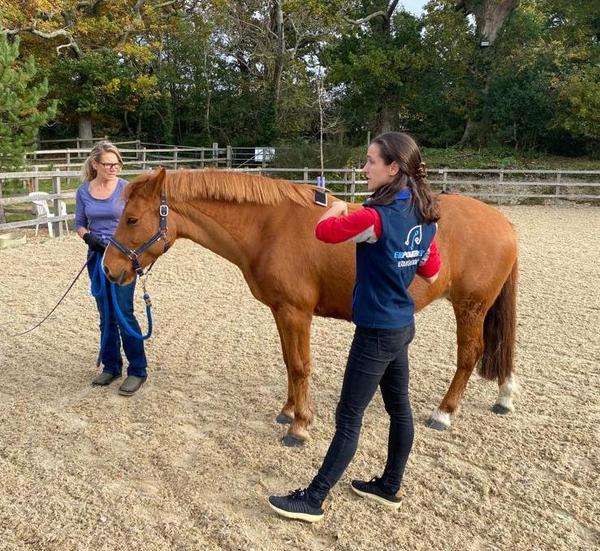
Here I am explaining how the gait analysis sensors work and what to watch for when doing measurements. This horse had a gait analysis done previously and it has undergone a rehabiliation programme since then. Interestingly, the amount of movement asymmetry I measured on the day was much reduced compared to the last time. This shows that gait analysis can be a useful tool
to objectively track progress.
In other news, I managed to get my second (whoop whoop) paper published before finishing my PhD 🤓 (note to self - I must get a move on! 😆). This is super exciting because publishing a
paper can take a while and there are usually a few rejections along the way... But hey, it's done and out (whoop whoop again). What did we concluded based on our results? - 'Subjectively scored improvement in lameness after diagnostic anesthesia was linked to changes in primary and compensatory
movement asymmetries.' => IN LAY TERMS: This means that sensors can reliably quantify change is movement asymmetries in horses and that these changes happen not just in the primary 'segment' (i.e. 'head nod' for forelimb lame horse) but also there are compensatory changes in the 'other end' of the horse (so in the case of forelimb lame horses, there will also be changes in withers and pelvis movement asymmetry).
- 'Changes in movement asymmetry can be influenced by exercise conditions.' => IN LAY TERMS: These movement asymmetry changes (before vs after blocking the limb) can be different depending on the surface the horses is evaluated on or whether they are trotting in a straight line or on a circle. But this was more the case for the withers than for the head or the pelvis.
The paper is available in the Journal of Equine Veterinary Science and it is open access (i.e. you don't have to pay to read it) so any nerdy equine ethusiasts out there head this way to read it: Changes in Head, Withers, and Pelvis Movement Asymmetry in Lame Horses as a Function of Diagnostic Anesthesia Outcome, Surface and Direction |
If you don't feel like braving a
full on research paper (I don't blame you 😆),
you can check out my slightly more 'digestible' resources about gait analysis below ⬇️
Blog - Introduction to Equine Gait Analysis
Until recently, objective evaluation of horse’s gaits would have been restricted to veterinary research institutions due to the cost of the equipment and the complexities of setting everything up correctly. Fortunately, we are getting to the exciting point when
equine gait analysis is becoming more accessible and affordable for the wider equestrian community.
|
|
|
|
Podcast - How gait analysis can help and support coaching and training of horses
Here I chat to Marianne from Dynamics Coaching and together we unpack the complexity of equine movement systems and and how gait analysis research is bringing new insights to our understanding of what is normal gait variability and what movement strategies may
be an indication of pain adaptations. We also discuss how gait analysis can be used to inform coaching and training practice design.
|
|
|
|
Webinar - Asymmetrical or lame? Where do we draw the line?
This webinar will help you understand normal movement patterns of horses and how movement symmetry of your horse can be impacted by different factors (for example: tack, riding style, movement on circles, pain). I delivered this webinar live in
November last year but the recording is available for purchase for only £5 and you can watch it anytime that suits your schedule.
|
|
|
|
|
There you go, you made it to the end of this newsletter 😊 and nearly to the end of this year too 🥳. I hope you have a lovely Christmas with your friends and family AND horses (I mean, they come under friends and family, right?) and I look
forward to connecting with you in one way or another in 2023 😊. Eva
P.S. I am always keen to hear what was helpful or what would like to see more of in future editions of the newsletter. Simply send me an email or message me on social media. |
Like, follow or subscribe!
(it genuinely makes my day)
|
|
|